

Which Hyundai Has the Lowest Insurance Cost?
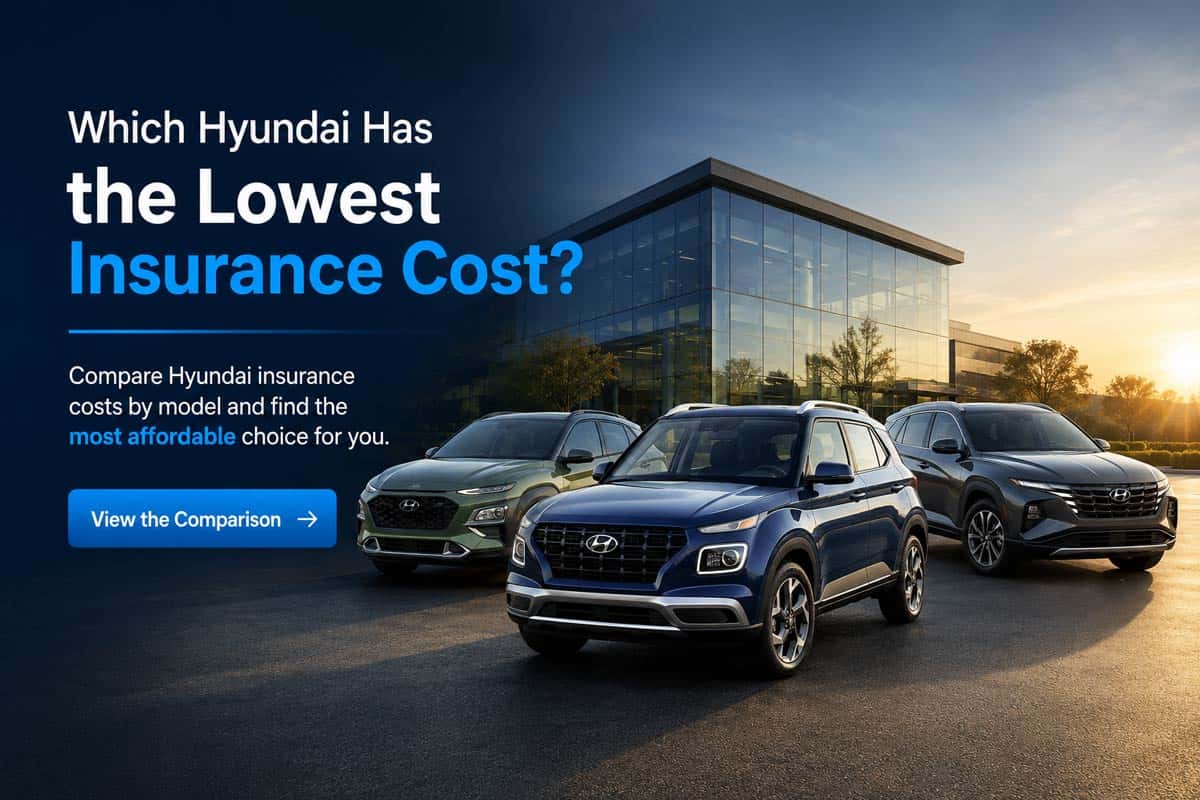
The Hyundai Venue is usually the cheapest Hyundai to insure. National rate comparisons show that full coverage costs about $1,999 per year, or $167 per month, for a 40-year-old driver with a clean record.
The Hyundai Kona and Tucson also have low insurance costs, with estimated yearly premiums of about $2,048 and $2,062. These numbers are national averages, but your rate may change depending on your location, age, driving record, model year, trim, coverage, and insurer.
Hyundai Insurance Cost Comparison by Model
The estimates below compare popular Hyundai models using the same driver profile and coverage details.
| Hyundai Model | Estimated Monthly Cost | Estimated Annual Cost | Relative Cost |
|---|---|---|---|
| Hyundai Venue | $167 | $1,999 | Lowest |
| Hyundai Kona | $171 | $2,048 | Very low |
| Hyundai Tucson | $172 | $2,062 | Very low |
| Hyundai Kona Electric | $190 | $2,276 | Moderate |
| Hyundai Santa Fe | $193 | $2,316 | Moderate |
| Hyundai Tucson Hybrid | $196 | $2,347 | Moderate |
| Hyundai Palisade | $197 | $2,360 | Moderate |
| Hyundai Santa Cruz | $198 | $2,376 | Moderate |
| Hyundai Elantra | $204 | $2,447 | Above average |
| Hyundai Santa Fe Hybrid | $205 | $2,460 | Above average |
| Hyundai Sonata | $220 | $2,639 | High |
| Hyundai Ioniq 5 | $227 | $2,721 | High |
| Hyundai Elantra N | $243 | $2,913 | Very high |
| Hyundai Ioniq 6 | $244 | $2,929 | Highest |
These rates are national estimates for full coverage and are not guaranteed quotes. They are based on a 40-year-old driver with a clean record. Actual premiums will vary by insurer and driver details.
Why Is the Hyundai Venue the Cheapest Hyundai to Insure?
The Hyundai Venue has features that help lower insurance costs. It is an affordable subcompact crossover with modest performance, a low replacement value, and a practical design.
Insurance companies look at more than just the purchase price. They also consider how often a model has claims, how costly those claims are, and what they might pay after a major accident or theft.
Lower Vehicle Replacement Cost
The Venue is one of the most affordable new cars in the U.S. Its lower value usually means the insurer pays less if the car is stolen or totaled.
This does not always mean you will get a low premium. Still, a lower replacement cost can help keep collision and comprehensive coverage more affordable than for bigger SUVs, performance cars, or premium electric vehicles.
Modest Performance
Cars with powerful engines often cost more to insure because insurers see higher performance as a bigger risk for claims.
The Venue is built for efficient daily driving, not for high performance. This helps it avoid the higher insurance costs that come with sportier models like the Hyundai Elantra N.
Practical Size and Intended Use
People often use the Venue for commuting, local trips, and daily driving. Its small size makes it easy to handle and park, especially in cities. A smaller vehicle is not automatically cheaper to insure, since crash protection and repairability also matter. Nevertheless, the Venue’s practical positioning, modest power, and low replacement value create a favorable overall insurance profile.
Competitive Repair Costs
Insurers look at the cost of parts, labor, sensor calibration, and repairs. Cars with complex lights, big wheels, pricey batteries, or special body panels can lead to expensive claims, even after minor accidents.
The Venue usually has a simpler engine and fewer expensive parts than Hyundai’s electric or performance models. This helps keep repair costs lower.
Hyundai Kona Insurance Cost
The Hyundai Kona is also one of the cheapest Hyundai vehicles to insure. National estimates put full coverage at about $2,048 per year, or $171 per month.
This means the Kona is only a bit more expensive to insure than the Venue. For most drivers, the difference is small, so it’s best to compare actual quotes, prices, features, and your own needs.
The Kona may cost more than the Venue because it can have:
- A higher purchase and replacement value
- More expensive trim levels
- Available turbocharged performance
- Larger wheels and tires
- More advanced technology
- Optional all-wheel drive
The insurance company you choose also matters. Estimates for the Hyundai Kona can vary a lot between companies, so it’s important to compare several insurers instead of relying on just one average.
Hyundai Tucson Insurance Cost
The Hyundai Tucson is another good choice if you want a Hyundai SUV with affordable insurance. Its estimated full-coverage premium is about $2,062 per year, or $172 per month.
Even though the Tucson is bigger than the Venue and Kona, it still has competitive insurance rates. Compact SUVs are popular with families and commuters. They often have easy-to-find parts, practical performance, and modern safety features. Safety ratings do not directly determine a premium, but favorable crash performance and effective collision-avoidance technology can influence an insurer’s model-specific loss data over time.
The Tucson is a practical choice if you need more room for passengers and cargo but don’t want a bigger, more expensive SUV.
Hyundai Elantra Insurance Cost
The Hyundai Elantra is affordable to purchase, but it is not currently the least expensive Hyundai to insure. Published estimates place its average full-coverage cost at approximately $2,447 per year, or $204 per month.
That is roughly $448 more per year than the estimated cost of insuring a Venue under the same benchmark profile.
Several factors may explain the difference:
- Sedans and crossovers can produce different claim patterns.
- The Elantra is available in several trims with different equipment.
- Certain model years may be affected by local theft trends.
- Younger or higher-risk drivers may be more likely to insure compact sedans.
- Repair costs can vary by model year and equipment package.
The Elantra still offers a potentially reasonable insurance cost compared with performance and electric Hyundai models. However, buyers should obtain a VIN-specific quote before assuming that its affordable purchase price will produce the lowest overall ownership cost.
Hyundai Santa Fe Insurance Cost
The Hyundai Santa Fe costs approximately $2,316 per year, or $193 per month, to insure under the national comparison profile.
Its premium is higher than the Venue, Kona, and Tucson, but the Santa Fe also provides more interior room and may include more expensive technology.
Potential contributors to its higher premium include:
- Greater vehicle value
- Larger body panels
- More expensive lighting assemblies
- Additional seating and interior equipment
- Higher repair costs after a collision
- More advanced sensors and cameras
- Available hybrid technology
The Santa Fe may still be competitively priced within its size class. We should compare it with similarly equipped midsize SUVs rather than only comparing it with Hyundai’s smallest vehicles.
Hyundai Palisade Insurance Cost
The Hyundai Palisade is estimated to cost approximately $2,360 per year, or $197 per month, for full coverage.
As a three-row SUV, the Palisade has a higher purchase price and replacement value than the Venue, Kona, or Tucson. Its larger body, premium interior features, and advanced technology can also increase repair costs.
Despite those factors, its estimated insurance cost remains below several Hyundai sedans, performance models, and electric vehicles. This shows that vehicle size alone does not determine the premium. Insurers assess historical losses across collision, property damage, bodily injury, comprehensive, and other coverage categories.
Hyundai Sonata Insurance Cost
The Hyundai Sonata is one of the more expensive conventional Hyundai models to insure. Its estimated full-coverage premium is approximately $2,639 per year, or $220 per month.
The Sonata’s higher estimated rate may reflect its vehicle value, repair complexity, claim history, and available performance-oriented equipment. The Sonata N Line, for example, delivers substantially more power than a base Venue or Tucson.
Drivers considering a Sonata should request quotes for the exact trim. A standard Sonata SEL and a more powerful N Line may not receive identical rates, even when registered to the same driver.
Why the Hyundai Elantra N Costs More to Insure
The Hyundai Elantra N is one of the most expensive Hyundai models to insure, with an estimated full-coverage cost of approximately $2,913 per year, or $243 per month.
Unlike the standard Elantra, the Elantra N is a dedicated performance model. It includes a turbocharged engine, sport-tuned components, specialized brakes, performance tires, and other equipment that can raise both claim frequency and repair severity.
Performance cars often cost more to insure because they may have:
- Greater acceleration capability
- Higher collision claim frequency
- More expensive wheels and tires
- Specialized suspension components
- Costlier body and powertrain parts
- A higher likelihood of being driven aggressively
- A smaller pool of inexpensive replacement components
A driver considering the Elantra N should compare insurance quotes before purchasing. The premium difference between the Elantra N and a standard Elantra can materially change the vehicle’s long-term ownership cost.
Are Hyundai Electric Vehicles More Expensive to Insure?
Hyundai electric vehicles generally cost more to insure than the Venue, Kona, and Tucson. The estimated annual full-coverage costs are approximately:
- Hyundai Kona Electric: $2,276
- Hyundai Ioniq 5: $2,721
- Hyundai Ioniq 6: $2,929
These estimates place the Ioniq 5 and Ioniq 6 among the most expensive Hyundai vehicles to insure.
Electric vehicles can generate higher repair costs because of their battery systems, specialized structural designs, electronic components, and technician requirements. Even when the high-voltage battery is undamaged, repairs may require extensive diagnostics and safety procedures.
Additional cost factors may include:
- Expensive battery-related components
- Specialized repair facilities
- Longer repair times
- High-cost sensors and cameras
- Aluminum or mixed-material body construction
- Limited aftermarket parts
- More expensive charging and electrical components
Not every driver will receive a higher EV quote. Insurance companies use different rating models, and some carriers may price a specific Hyundai EV more competitively than others.
How Hyundai Safety Features Affect Insurance Costs
Many Hyundai vehicles include Hyundai SmartSense driver-assistance technologies. Depending on the model and trim, these systems may include forward collision-avoidance assistance, lane-keeping assistance, blind-spot monitoring, rear cross-traffic assistance, and driver-attention warnings.
Advanced safety systems can influence insurance costs in two competing ways.
First, they may reduce the frequency or severity of some accidents. Avoiding a collision can prevent an insurance claim entirely.
Second, these systems may increase repair costs. A bumper replacement may require sensor replacement, camera aiming, or radar calibration. A windshield replacement may also require recalibrating a forward-facing camera.
Therefore, the presence of advanced safety equipment does not guarantee a discount. Insurers generally evaluate the model’s real-world claims experience rather than assuming every safety feature will lower every part of the premium.
Hyundai Theft Risk and Insurance Rates
Theft risk can significantly affect comprehensive insurance rates, particularly for certain older Hyundai vehicles.
Some model-year 2011–2022 Hyundai vehicles were sold without an electronic engine immobilizer. Hyundai subsequently introduced a free anti-theft software upgrade for millions of eligible vehicles. NHTSA has also documented the campaign and encouraged affected owners to obtain the available protection.
Research from the Highway Loss Data Institute found that eligible Hyundai and Kia vehicles receiving the software upgrade experienced lower theft claim frequency than vehicles that had not received it. However, claim frequency for affected vehicles remained elevated in some reporting periods.
When buying or insuring a used Hyundai, we should:
- Confirm whether the vehicle has a push-button or keyed ignition.
- Check whether it was originally equipped with an immobilizer.
- Verify whether the anti-theft software update was completed.
- Ask the insurer whether the model year is subject to restrictions or surcharges.
- Request a quote using the exact VIN.
- Keep documentation showing that the upgrade was installed.
- Consider a visible steering-wheel lock or additional anti-theft device.
Some insurers may treat two Hyundai vehicles differently even when they share the same model name. Model year, ignition type, location, and anti-theft equipment can materially affect eligibility and price.
What Determines the Cost of Hyundai Insurance?
The model matters, but it is only one part of the premium calculation.
Driver Age
Younger drivers typically pay more because they have less driving experience and historically generate more frequent or severe claims.
A Venue may be the cheapest Hyundai for a 40-year-old driver but may still be expensive when insured by a teenager or newly licensed driver.
Driving Record
Speeding tickets, at-fault accidents, reckless-driving convictions, and driving under the influence can raise premiums substantially.
A driver with a clean record will generally receive a lower rate than a driver with several recent violations, even when both insure the same vehicle.
ZIP Code and State
Insurance costs vary widely by location. Insurers consider:
- Accident frequency
- Vehicle theft rates
- Repair labor costs
- Medical costs
- Weather-related losses
- Lawsuit frequency
- Insurance regulations
- Population density
- Uninsured-driver rates
A Hyundai Venue insured in a small town may receive a different premium from an identical Venue kept in a dense urban neighborhood.
Credit-Based Insurance Score
In states where the practice is permitted, insurers may use a credit-based insurance score when calculating premiums.
The effect varies by company and jurisdiction. Some states prohibit or restrict the use of credit information in auto insurance pricing.
Annual Mileage
Drivers who spend more time on the road generally have greater exposure to accidents. A long daily commute can therefore increase the premium.
Low-mileage drivers may qualify for discounts or usage-based insurance, depending on the carrier.
Coverage Limits
A liability-only policy usually costs less than full coverage because it does not include collision and comprehensive protection for the insured vehicle.
However, selecting only minimum coverage can leave a driver financially exposed after a serious accident. State minimums may not be sufficient to cover major injuries or property damage.
Deductible
A higher collision or comprehensive deductible can reduce the premium because the policyholder accepts a larger share of each covered loss.
For example, a policy with a $1,000 deductible may cost less than one with a $500 deductible. However, the deductible should remain affordable in case a claim occurs.
Model Year
Newer Hyundai vehicles often cost more to insure because they have higher replacement values and more expensive technology.
An older vehicle may have a lower collision premium, but that advantage can be reduced by poor theft history, limited safety technology, or high parts costs.
Trim Level
Two vehicles with the same model name may receive different premiums.
A higher trim may add:
- A turbocharged engine
- Larger wheels
- Premium headlights
- Panoramic glass
- Additional cameras
- Radar sensors
- Expensive interior equipment
- All-wheel drive
- Performance brakes
We should compare insurance using the exact trim and VIN rather than relying only on a model-wide average.
Insurance Company
Each insurer uses its own claims data, underwriting rules, and discount structure. One company may offer the lowest rate for a Venue, while another may be more competitive for a Tucson or Santa Fe.
For that reason, changing insurers can sometimes produce greater savings than changing from one Hyundai model to another.
How to Find the Cheapest Hyundai to Insure
Compare Exact VINs
A generic model estimate is useful for early research, but a VIN-specific quote is more accurate. The VIN identifies the model year, trim, engine, body style, and factory equipment.
Before purchasing, we should obtain quotes for the actual vehicles under consideration.
Use Identical Coverage for Every Quote
A fair comparison requires matching:
- Liability limits
- Collision deductible
- Comprehensive deductible
- Uninsured-motorist coverage
- Medical coverage
- Rental reimbursement
- Roadside assistance
- Annual mileage
- Listed drivers
A quote with lower limits or higher deductibles may appear cheaper even though it provides less protection.
Compare Several Insurers
Rates can vary by hundreds or even thousands of dollars per year between companies. We should compare national carriers, regional insurers, and eligible membership-based companies.
Check Discounts
Available discounts may include:
- Multi-policy discount
- Multi-vehicle discount
- Safe-driver discount
- Good-student discount
- Low-mileage discount
- Automatic-payment discount
- Paid-in-full discount
- Defensive-driving discount
- Telematics discount
- Anti-theft discount
Discount names and eligibility requirements vary by insurer and state.
Recheck Insurance Before Renewal
The cheapest insurer today may not remain the cheapest after a renewal. Premiums can change because of statewide rate filings, claim trends, repair inflation, and changes in the policyholder’s profile.
We should compare rates periodically, especially after a major increase.
Cheapest Hyundai for a Teen Driver
The Hyundai Venue may be one of the least expensive current Hyundai models to insure, but teen-driver premiums can still be high.
For a young driver, we should generally prioritize:
- Strong crash protection
- Moderate engine output
- Automatic emergency braking
- Lane-departure warning
- Affordable replacement parts
- Reliable transportation
- No performance modifications
- A clean title and documented history
The Venue, Kona, and Tucson may be worth quoting. However, the cheapest result will depend on the teen’s location, household policy, driving record, school-related discounts, and selected coverage.
A used vehicle is not automatically cheaper to insure. An older Hyundai affected by theft concerns may receive a higher comprehensive premium or may be difficult to insure through certain carriers.
Cheapest Used Hyundai to Insure
A used Venue, Kona, or Tucson may provide a favorable combination of vehicle price and insurance cost. Still, the model year requires careful review.
Before buying a used Hyundai, we should investigate:
- Theft-related insurance restrictions
- Immobilizer equipment
- Completion of anti-theft updates
- Open safety recalls
- Accident history
- Title status
- Previous structural damage
- Airbag deployment
- Current market value
- Availability of replacement parts
An older vehicle with a lower market price may reduce collision and comprehensive costs. However, the savings can disappear when the vehicle has a high theft rate, expensive repair history, or limited insurer availability.
Does Liability-Only Coverage Make a Hyundai Cheaper to Insure?
Liability-only coverage can substantially reduce the premium because it does not pay to repair or replace the insured Hyundai after a collision, theft, fire, flood or vandalism.
However, liability-only coverage is usually unsuitable for:
- Financed vehicles
- Leased vehicles
- Newer vehicles
- Vehicles the owner cannot afford to replace
- Vehicles the owner relies on for daily transportation
Lenders normally require collision and comprehensive coverage. Even without a loan, dropping physical-damage coverage should be based on the vehicle’s value, the premium savings, and the owner’s financial ability to absorb a total loss.
Final Thoughts
The Hyundai Venue is generally the cheapest Hyundai to insure, with an estimated full-coverage cost of approximately $167 per month or $1,999 per year. The Hyundai Kona follows at approximately $171 per month, while the Hyundai Tucson averages approximately $172 per month.
The difference between these three models is relatively small, so an individual insurer may rank them differently based on the driver, location, model year, and trim. For that reason, national averages should be treated as a starting point rather than a guaranteed price.
Before purchasing a Hyundai, we recommend requesting quotes for the exact vehicles under consideration. A VIN-specific quote provides the clearest picture of what it will cost to insure a particular model year, trim, and powertrain.
For drivers focused primarily on the lowest insurance cost, the Hyundai Venue should be the first model to compare. Those who need more space, available all-wheel drive, or additional features should also consider the Kona and Tucson.
Shop Used Hyundai Models
Find an Affordable Used Hyundai at PA Auto Sales
If you are shopping for a used Hyundai, explore the available models at PA Auto Sales. Our inventory may include popular Hyundai cars and SUVs known for practical features, competitive ownership costs, and affordable insurance estimates. Extended warranty and vehicle protection options may also be available on qualifying models.
Compare available Hyundai models, review vehicle details, and find the right balance of price, condition, features, and long-term value.





0 comment(s) so far on Which Hyundai Has the Lowest Insurance Cost?