

What Is Good About Range Rover? Luxury, Comfort and More
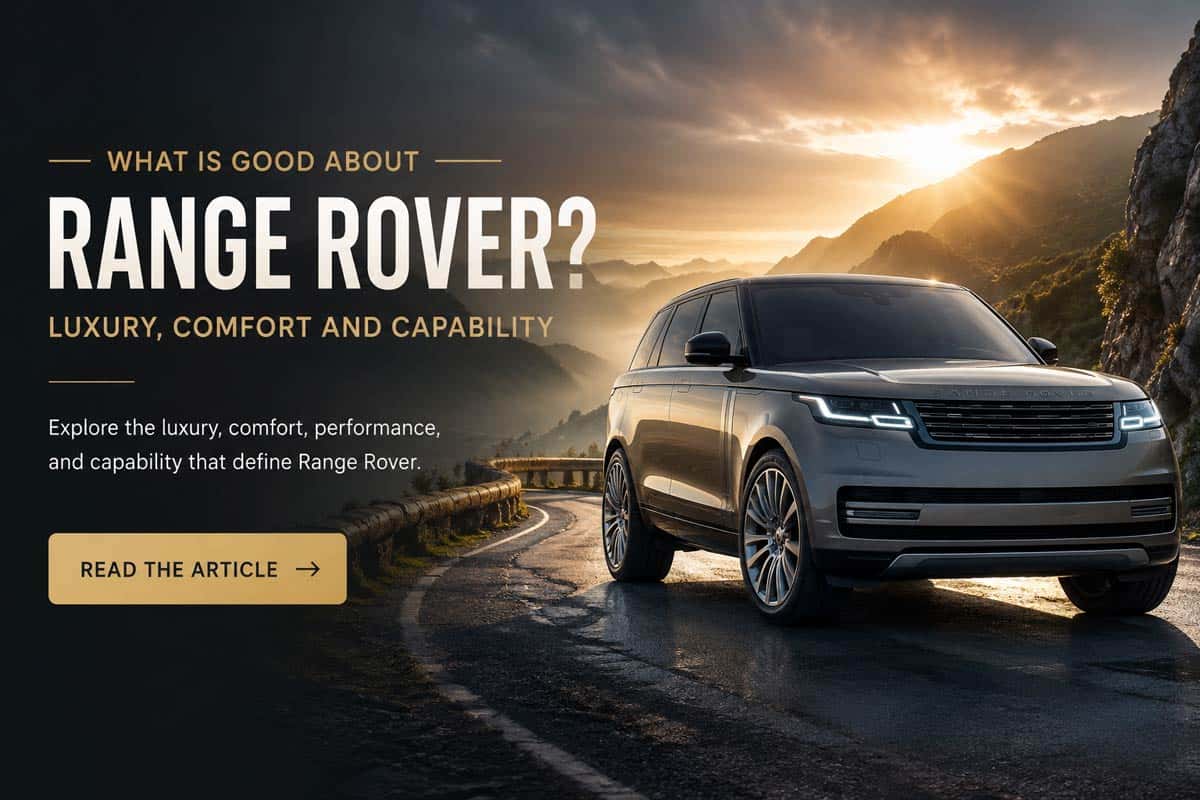
Range Rover is good because it combines genuine off-road capability, premium comfort, confident performance, and unmistakable design in one luxury SUV. While many high-end SUVs focus primarily on road comfort or sporty handling, Range Rover is engineered to remain composed on highways, city streets, snow-covered roads, and challenging terrain.
The flagship Range Rover is particularly known for its smooth air suspension, quiet cabin, commanding driving position, advanced four-wheel-drive technology, and highly configurable interior. The wider Range Rover family also offers buyers several choices, including the performance-focused Range Rover Sport, the design-led Range Rover Velar, and the compact Range Rover Evoque.
What Makes Range Rover So Special?
Range Rover occupies a distinctive position in the luxury SUV market. It offers the presence and interior refinement expected from a premium vehicle while retaining the engineering needed for demanding conditions.
Its main strengths include:
- Exceptionally smooth ride quality
- Luxurious and spacious interior
- Advanced all-wheel-drive capability
- Strong gas, hybrid, and high-performance powertrains
- Impressive visibility and driving position
- Distinctive exterior design
- Sophisticated driver-assistance technology
- Available seating for up to seven adults
- Broad personalization options
- Strong heritage dating back to 1970
The result is an SUV that can function as a comfortable daily driver, family vehicle, long-distance cruiser, executive vehicle, or capable all-terrain machine.
1. Range Rover Delivers Exceptional Ride Comfort
Ride quality is one of the strongest reasons people choose a Range Rover. The suspension is designed to isolate occupants from rough pavement, expansion joints, potholes, and uneven surfaces without making the vehicle feel uncontrolled.
Current flagship models use electronic air suspension and adaptive damping technology. The system continuously monitors vehicle and steering movements, then adjusts the suspension to improve comfort and body control. Range Rover states that its Adaptive Dynamics technology monitors movement up to 500 times per second.
This creates a composed driving experience in several situations:
- The suspension absorbs sharp road imperfections.
- Body movement is controlled during cornering.
- The vehicle remains stable at highway speeds.
- Ride height can adapt to different driving conditions.
- Access height can lower the vehicle to make entry and exit easier.
- Additional clearance can be provided for difficult terrain.
Unlike some performance-oriented luxury SUVs, the Range Rover does not need an excessively firm suspension to feel controlled. It prioritizes smoothness while still maintaining confident road manners.
Why Range Rover Feels So Comfortable on Long Drives
Several elements work together to reduce fatigue:
- Supportive seating: Available multi-adjustable seats help drivers establish a natural seating position.
- High driving position: The elevated view makes it easier to monitor surrounding traffic.
- Controlled suspension: The air suspension reduces harsh vertical movements.
- Quiet cabin: Wind, tire, and engine noise are carefully managed.
- Stable highway behavior: The vehicle feels substantial and planted at speed.
- Personal climate settings: Available four-zone climate control lets multiple occupants choose individual temperature settings.
For buyers who regularly travel long distances, this combination can be more valuable than acceleration figures or aggressive handling.
2. The Interior Feels Like a True Luxury Environment
Range Rover interiors are designed around simplicity, comfort, and material quality. Instead of filling the dashboard with unnecessary visual elements, the cabin generally uses clean horizontal lines, large surfaces, and carefully integrated controls.
Depending on the trim and configuration, interior materials may include:
- Windsor or semi-aniline leather
- Premium textile alternatives
- Real wood veneer
- Metal trim
- Ceramic-finished controls
- Soft-touch dashboard and door surfaces
- Configurable ambient lighting
- Premium carpeting
- Heated armrests
- Heated, ventilated, and massaging seats
The flagship model can also be equipped with Executive Class Rear Seating. Available rear-seat controls allow passengers to manage comfort and entertainment functions from a touchscreen integrated into the center armrest.
Rear-Seat Comfort Is a Major Strength
Range Rover does not treat the second row as an afterthought. In higher configurations, rear passengers can receive features commonly associated with executive sedans, including:
- Power-adjustable reclining seats
- Heating and ventilation
- Massage functions
- Rear entertainment screens
- Power sunshades
- Deployable center console
- Individual climate settings
- USB and power connections
- Refrigerator compartment availability
This makes the flagship Range Rover suitable for buyers who spend substantial time in the rear seat as well as those who prefer to drive.
3. Range Rover Offers Genuine Off-Road Capability
Many premium SUVs have all-wheel drive, but relatively few are designed for demanding off-road use. Range Rover distinguishes itself through hardware and software specifically developed for low-traction surfaces and uneven terrain.
Depending on the model and configuration, capability systems may include:
- Permanent all-wheel drive
- Terrain Response 2
- Configurable Terrain Response
- Twin-speed transfer case with low range
- Electronic active differential
- Torque vectoring by braking
- Hill Descent Control
- Hill Launch Assist
- Low-traction launch
- Electronic traction control
- All Terrain Progress Control
- Adaptive Off-Road Cruise Control
- Adjustable electronic air suspension
The flagship model’s specification list includes Terrain Response 2, a twin-speed transfer box, Hill Descent Control and available Adaptive Off-Road Cruise Control.
How Terrain Response Helps the Driver
Terrain Response adjusts several vehicle systems according to the selected surface. Depending on the model, it may modify:
- Throttle sensitivity
- Transmission shift strategy
- Traction-control intervention
- Center and rear differential behavior
- Suspension height
- Stability-control settings
- Hill-descent operation
Rather than requiring the driver to configure each system individually, Range Rover coordinates them through a single terrain program.
Typical modes may be designed for:
- General driving
- Grass, gravel, and snow
- Mud and ruts
- Sand
- Rock crawling
- Wading
- Dynamic road driving
This does not eliminate the need for careful driving, appropriate tires, or an understanding of the terrain. It does, however, make the vehicle more adaptable than a road-focused luxury crossover.
4. It Maintains Comfort Even When the Road Ends
Off-road ability is not useful if the vehicle becomes uncomfortable as soon as the pavement ends. Range Rover’s advantage is its ability to combine suspension travel and traction with a refined cabin.
On gravel, deeply rutted roads, or uneven trails, electronic air suspension helps the wheels follow changes in the surface. Traction systems manage wheelspin, while cameras can help the driver see obstacles close to the vehicle.
Available ClearSight Ground View technology uses exterior cameras to display the area beneath and immediately ahead of the front of the vehicle. The system can be useful when approaching rocks, narrow tracks, curbs or other obstacles that are difficult to see from the driver’s seat.
This balance makes Range Rover attractive to buyers who want serious capability without accepting the noise, vibration, and basic interior commonly associated with traditional off-road vehicles.
5. The Commanding Driving Position Improves Confidence
A Range Rover places the driver high in the cabin with a wide view through the windshield. The hood remains visible, which helps convey the vehicle’s size and position.
This elevated seating position offers several practical benefits:
- Better visibility in traffic
- Easier observation of vehicles ahead
- Improved awareness of narrow roads
- Greater confidence when parking
- A clearer view of uneven terrain
- Comfortable entry and exit when the suspension is lowered
The upright architecture also provides generous headroom and reduces the enclosed feeling found in some coupe-style SUVs.
Although the Range Rover is a large vehicle, available surround-view cameras, parking sensors, and all-wheel steering help make it easier to maneuver.
6. All-Wheel Steering Makes a Large SUV Easier to Handle
The full-size Range Rover is substantial, especially in long-wheelbase form. All-wheel steering helps reduce the effort required to maneuver it.
At lower speeds, the rear wheels can turn in the opposite direction from the front wheels. This effectively shortens the turning circle and makes the vehicle easier to position in parking areas, driveways, and narrow streets.
At higher speeds, the rear wheels can turn in the same direction as the front wheels. This improves stability during lane changes and sweeping turns.
The current flagship has a turning circle of approximately 35.11 feet in standard-wheelbase form and 37.10 feet in long-wheelbase form.
That level of maneuverability is especially valuable because luxury SUV owners often use their vehicles in urban and suburban environments rather than exclusively on open roads.
7. Buyers Can Choose from Several Strong Powertrains
Range Rover offers different powertrain personalities rather than forcing every buyer into the same configuration.
Depending on the model year and trim, choices may include:
- Turbocharged six-cylinder gas engines
- Mild-hybrid gas engines
- Plug-in hybrid powertrains
- Twin-turbocharged V8 engines
- High-performance SV configurations
Six-Cylinder Engines
The turbocharged inline-six is generally the most balanced option for everyday use. It provides smooth power delivery, capable acceleration, and a more restrained character than the V8.
It is well suited to drivers who prioritize:
- Quiet operation
- Daily comfort
- Highway cruising
- Reasonable performance
- Lower purchase and operating costs than top V8 models
Plug-In Hybrid Range Rover
The plug-in hybrid combines a six-cylinder gas engine with an electric motor and a rechargeable battery. It can travel in electric mode for shorter journeys while retaining a gas engine for longer trips.
The current flagship Range Rover PHEV is advertised with an EPA-estimated electric range of up to 50 miles when fully charged. However, the actual range varies according to temperature, speed, driving style, and other conditions.
A plug-in hybrid can be particularly attractive for an owner who:
- Can charge at home
- Has a predictable daily commute
- Wants quiet electric driving around town
- Frequently takes longer highway trips
- Does not want to depend entirely on the charging infrastructure
The benefits are greatest when the battery is charged regularly. Driving a plug-in hybrid without charging it reduces the advantage of carrying the electric hardware.
V8 Performance
The V8 provides stronger acceleration, effortless passing power, and a more distinctive engine character. It suits buyers who value performance and are comfortable with higher fuel, maintenance, and purchase costs.
High-output SV models add more aggressive acceleration while preserving the comfort and luxury expected from the flagship.
8. Range Rover Can Be a Practical Family SUV
Although its image is closely associated with luxury, Range Rover can also be a practical family vehicle.
The flagship is available in standard-wheelbase and long-wheelbase forms. Certain long-wheelbase configurations provide three rows and seating for up to seven adults.
Practical features may include:
- Available three-row seating
- Wide rear-door openings
- Power-folding rear seats
- Multiple climate zones
- Rear entertainment
- Numerous charging ports
- Large cargo area
- Adjustable suspension height
- Split rear tailgate
- Available towing equipment
- Washable cargo accessories
The Split Tailgate Is More Useful Than It Looks
The Range Rover’s traditional split tailgate consists of an upper liftgate and a lower section that folds outward.
The lower section can serve several purposes:
- A temporary seat
- A loading platform
- A place to change footwear
- A barrier that helps prevent cargo from rolling out
- A surface for outdoor events
- Easier access to items near the rear of the cargo area
It is one of the model’s defining practical features and has been associated with the Range Rover since the original production vehicle. The first model introduced in 1970 combined permanent four-wheel drive with a split tailgate, clamshell hood, and continuous waistline.
9. The Technology Is Designed to Reduce Driver Workload
Range Rover uses technology to support visibility, comfort, navigation, and vehicle control.
Depending on the model, available features may include:
- Digital instrument display
- Head-up display
- Central touchscreen
- Wireless Apple CarPlay
- Wireless Android Auto
- Connected navigation
- Voice control
- Wireless phone charging
- Remote vehicle application
- 3D surround-view camera
- ClearSight Ground View
- Digital rearview mirror
- Adaptive cruise control
- Blind-spot monitoring
- Lane-keeping assistance
- Rear traffic monitoring
- Traffic-sign recognition
- Automatic emergency braking
The ClearSight interior mirror is especially useful when passengers or cargo block the conventional rearward view. It can display a live camera image from the rear of the vehicle.
The Remote app can also provide access to selected vehicle information and controls from a compatible smartphone.
Technology Should Still Be Tested Before Purchase
Advanced systems can add convenience, but they also increase complexity. When evaluating a used Range Rover, we recommend testing every major electronic function rather than assuming that a warning-free dashboard means everything works.
Important items to test include:
- Touchscreen response
- Cameras
- Parking sensors
- Seat adjustment
- Heating and ventilation
- Massage functions
- Climate zones
- Power tailgate
- Digital mirror
- Keyless entry
- Phone connectivity
- Suspension height adjustment
- Driver-assistance systems
10. Range Rover Has One of the Most Recognizable SUV Designs
Range Rover styling has evolved without abandoning the proportions that made the original recognizable.
Common design elements include:
- Upright body
- Clamshell hood
- Floating roof appearance
- Continuous waistline
- Short front overhang
- Strong shoulder line
- Minimal exterior decoration
- Vertically oriented rear lighting
- Clean, formal profile
This restrained approach helps Range Rover avoid looking overly dependent on short-lived design trends.
The original production Range Rover was introduced in 1970. It combined four-wheel-drive capability with elegant design, helping define the modern luxury SUV category.
11. The Range Rover Family Offers Different Personalities
“Range Rover” may refer to the flagship vehicle or the wider family of Range Rover SUVs. Choosing the right Range Rover depends on how much space, performance and luxury the buyer needs.
| Model | Primary Strength | Best Suited For |
|---|---|---|
| Range Rover | Maximum comfort, space and prestige | Luxury-focused buyers, families and executive travel |
| Range Rover Sport | More athletic handling and performance | Drivers who want luxury with a sportier character |
| Range Rover Velar | Sleek design and manageable proportions | Style-focused buyers and everyday road use |
| Range Rover Evoque | Compact size and urban maneuverability | City driving, smaller households and easier parking |
Full-Size Range Rover
The flagship offers the highest levels of comfort, rear-seat luxury, powertrain options, and interior space. It is the best choice when refinement is the main priority.
Range Rover Sport
The Range Rover Sport has a more driver-focused personality. It usually feels more responsive and athletic while maintaining substantial off-road ability and cabin refinement.
Range Rover Velar
The Velar emphasizes streamlined styling and a minimalist interior. It is easier to place on narrow roads than the flagship and offers more space than the Evoque.
Range Rover Evoque
The Evoque packages Range Rover design into a compact footprint. It is suited to drivers who want the brand’s styling and premium atmosphere without the size of a full-size luxury SUV.
Which Range Rover Is Right for You?
| Step | Decision | Options | Next Step |
|---|---|---|---|
| 1 | Choose a Range Rover | Start | What matters most? |
| 2 | What matters most? | Maximum luxury and space | Range Rover |
| 2 | What matters most? | Performance and handling | Range Rover Sport |
| 2 | What matters most? | Design and everyday usability | Range Rover Velar |
| 2 | What matters most? | Compact size and city driving | Range Rover Evoque |
| 3 | Need a third row? | Yes | Long-Wheelbase Seven-Seat |
| 3 | Need a third row? | No | Standard or Long-Wheelbase Five-Seat |
| 4 | Preferred powertrain? | Balanced daily driving | Six-Cylinder |
| 4 | Preferred powertrain? | Short electric commutes | Plug-In Hybrid |
| 4 | Preferred powertrain? | Maximum performance | V8 or SV |
Is Range Rover Reliable?
Range Rover reliability depends heavily on the model year, powertrain, maintenance history, and previous ownership.
These vehicles contain complex systems, including air suspension, advanced electronics, turbocharged engines, all-wheel-drive hardware, and numerous comfort features. That complexity contributes to the driving experience, but it can also increase repair costs as the vehicle ages.
A Range Rover should not be evaluated in the same way as a basic compact SUV. Buyers should budget based on the vehicle’s original price and technical complexity, not just the lower purchase price of a depreciated used example.
What Improves the Chances of a Good Ownership Experience?
We recommend prioritizing:
- Complete service records
- Correct maintenance intervals
- A clean vehicle-history report
- No unresolved warning lights
- Consistent suspension height
- Smooth transmission operation
- A properly functioning cooling system
- Even tire wear
- A professional pre-purchase inspection
- Warranty coverage where available
New Land Rover vehicles in the United States receive a four-year or 50,000-mile limited warranty. Approved certified pre-owned vehicles may include either one year of unlimited-mile coverage or two years of coverage up to 100,000 miles, depending on the program terms and vehicle.
What Should We Inspect When Buying a Used Range Rover?
A low advertised price should never replace a thorough inspection. We recommend checking the following areas before purchase.
Service History
Look for evidence of regular:
- Engine oil changes
- Coolant service
- Brake-fluid replacement
- Transmission and differential maintenance
- Spark-plug replacement
- Belt and hose inspection
- Software updates
- Recall completion
Missing records do not automatically mean the vehicle was neglected, but they increase uncertainty.
Air Suspension
Confirm that the vehicle:
- Raises and lowers normally
- Sits level after being parked
- Does not display suspension warnings
- Does not produce excessive compressor noise
- Maintains the selected ride height
A vehicle leaning at one corner after sitting may require further diagnosis.
Cooling System
Check for:
- Coolant odor
- Visible leaks
- Low coolant level
- Overheating history
- Warning messages
- Cracked hoses or reservoirs
- Evidence of previous cooling-system repairs
Cooling problems should be investigated immediately because overheating can lead to more expensive damage.
Electronics and Interior Features
Operate every seat, window, camera, climate-control zone, charging port, and infotainment function. Luxury features add value only when they work correctly.
Tires and Alignment
Large wheels and heavy curb weight can make premium tires expensive. Uneven wear may indicate alignment, suspension, or driving-related issues.
Check:
- Tread depth
- Matching tire brands and models
- Correct load rating
- Sidewall damage
- Inner-edge wear
- Wheel damage
- Steering vibration
Brakes
Inspect rotor condition, pad thickness, and service records. Large luxury SUVs use substantial braking components, and replacement costs can be higher than those of ordinary passenger vehicles.
Plug-In Hybrid Battery and Charging Equipment
For a PHEV, verify:
- Battery charge level
- Electric driving operation
- Charging-port condition
- Charging-cable availability
- Estimated electric range
- Hybrid warning messages
- Remaining battery warranty
Range Rover Advantages and Disadvantages
| Advantages | Disadvantages |
|---|---|
| Outstanding ride comfort | Higher maintenance and repair costs |
| Genuine all-terrain capability | Complex mechanical and electronic systems |
| Premium interior materials | Large wheels can increase tire costs |
| Strong road presence | Some models have high fuel consumption |
| Excellent driving position | Depreciation can be substantial |
| Available seven-seat configuration | Large exterior dimensions |
| Gas, hybrid and V8 choices | Used examples require careful inspection |
| Advanced camera and assistance systems | Option packages can significantly increase price |
| Distinctive design | Insurance may be expensive |
| Strong personalization options | Not ideal for buyers seeking minimal ownership costs |
Why Do People Like Range Rovers So Much?
People like Range Rovers because few vehicles deliver the same combination of prestige, comfort, visibility, and capability.
A Range Rover feels appropriate in a wide range of environments. It can arrive at a formal event without looking utilitarian, travel across a snow-covered road without feeling fragile, and carry a family without losing its premium character.
The appeal is not based on one feature. It comes from the way several qualities work together:
- The cabin feels calm and substantial.
- The driver sits in a commanding position.
- The suspension smooths difficult roads.
- The design is immediately recognizable.
- The four-wheel-drive system provides confidence.
- The interior can be configured for families or executive travel.
- The powertrains provide effortless performance.
That breadth is what separates Range Rover from many luxury vehicles that excel in only one area.
Is a Range Rover Comfortable?
Yes. Comfort is one of the flagship Range Rover’s defining characteristics.
Electronic air suspension, adaptive damping, supportive seating, available massage functions, multiple climate zones, and a quiet cabin contribute to a relaxed experience. Long-wheelbase versions provide additional rear legroom, while selected configurations offer three rows.
The Range Rover Sport is also comfortable, although its tuning generally places greater emphasis on responsive handling.
Is a Range Rover Good in Snow?
Range Rover can be highly capable in snow when equipped with suitable tires.
All-wheel drive, Terrain Response, traction control, adjustable suspension, and low-traction driving systems can help the vehicle manage slippery conditions. However, no electronic system can compensate for worn or inappropriate tires.
For regular winter driving, we recommend using quality winter or severe-snow-rated tires in the correct size and load rating.
Is Range Rover Good for Families?
Range Rover can be an excellent family SUV, especially in long-wheelbase or seven-seat form.
Its strengths for families include:
- Spacious seating
- Available third row
- Wide-opening doors
- Multiple climate zones
- Rear entertainment options
- Strong cargo capacity
- Numerous charging connections
- Advanced parking cameras
- Comfortable highway ride
Families should compare the exact seating configuration because not every Range Rover includes a third row.
Is a Range Rover Good for Long-Distance Driving?
Range Rover is particularly well suited to long journeys. The smooth suspension, supportive seats, quiet cabin, and stable highway behavior reduce fatigue.
Six-cylinder and plug-in hybrid models generally provide the most balanced long-distance experience. A V8 delivers greater performance but may require more frequent fuel stops.
Is It Expensive to Maintain a Range Rover?
A Range Rover is typically more expensive to maintain than a non-luxury SUV, so understanding maintenance costs is important before buying.
Costs can include:
- Premium tires
- Larger brake components
- Specialized fluids
- Complex suspension parts
- Advanced electronics
- Higher labor rates
- Premium fuel for many engines
- More expensive insurance
Maintenance costs should be considered before purchasing, particularly when evaluating an older model without warranty coverage.
Is a Used Range Rover Worth Buying?
A used Range Rover can be a good buy when it has been properly maintained, thoroughly inspected, and priced with future operating costs in mind.
The best used example is not always the least expensive one. Paying more for documented service history, better condition, and warranty protection may reduce financial risk.
A used Range Rover may be a good choice for someone who values:
- Luxury and comfort
- Distinctive styling
- Strong all-weather capability
- Premium interior quality
- Powerful engines
- A commanding driving position
It may not be the right choice for someone whose main priorities are low repair costs, maximum fuel economy, or basic transportation.
Is Range Rover Worth It?
The Range Rover is worth considering when we want a luxury SUV that can serve multiple roles.
Its strongest quality is balance. It can be refined without feeling delicate, capable without feeling utilitarian, and powerful without sacrificing comfort. The flagship is especially compelling for buyers who value ride quality, interior atmosphere, road presence, and all-terrain confidence.
The tradeoff is ownership cost. Range Rover offers a complex, well-equipped vehicle, so maintenance, tires, fuel, and repairs can be more expensive than those of simpler SUVs.
For the right owner, however, few vehicles provide the same combination of luxury, versatility, heritage, and capability.
Conclusion
What is good about the Range Rover is its ability to combine luxury, comfort, performance, and authentic off-road capability into a single distinctive SUV. It offers a smooth and quiet ride, a commanding driving position, premium interior materials, advanced four-wheel-drive technology, and a wide selection of powerful gas, hybrid, and V8 powertrains.
The flagship Range Rover is best suited to buyers who prioritize maximum comfort, space and prestige, while the Range Rover Sport, Velar and Evoque offer sportier, sleeker and more compact alternatives. Across the lineup, the brand’s strongest advantage remains its versatility. A Range Rover can handle everyday commuting, long highway journeys, family travel, winter conditions, and challenging terrain without losing its refined character.
Ownership costs can be higher than those of a conventional SUV, particularly as the vehicle ages. For that reason, maintenance history, condition, warranty coverage, and a professional pre-purchase inspection should play a major role when buying used.
For buyers who understand those costs and value comfort, capability, and unmistakable design, a Range Rover remains one of the most complete and desirable luxury SUVs on the market.





0 comment(s) so far on What Is Good About Range Rover? Luxury, Comfort and More